Fall Porch Decorating Ideas 2026: 11 That Last the Whole Season
Every fall porch you’ve saved is a photograph taken on its first day. The mums are at peak bloom, the pumpkins are unblemished, and nothing has been rained on yet. Yours has to hold that look for about ten weeks, outdoors, in weather.
That gap is what these fall porch decorating ideas are built around — a porch that still looks good in the third week of October, not just on the afternoon you finish it.
And it starts with the object at the centre of nearly every fall porch: the mums. Which are sold to you with an implication that isn’t quite true.
The mum problem nobody mentions
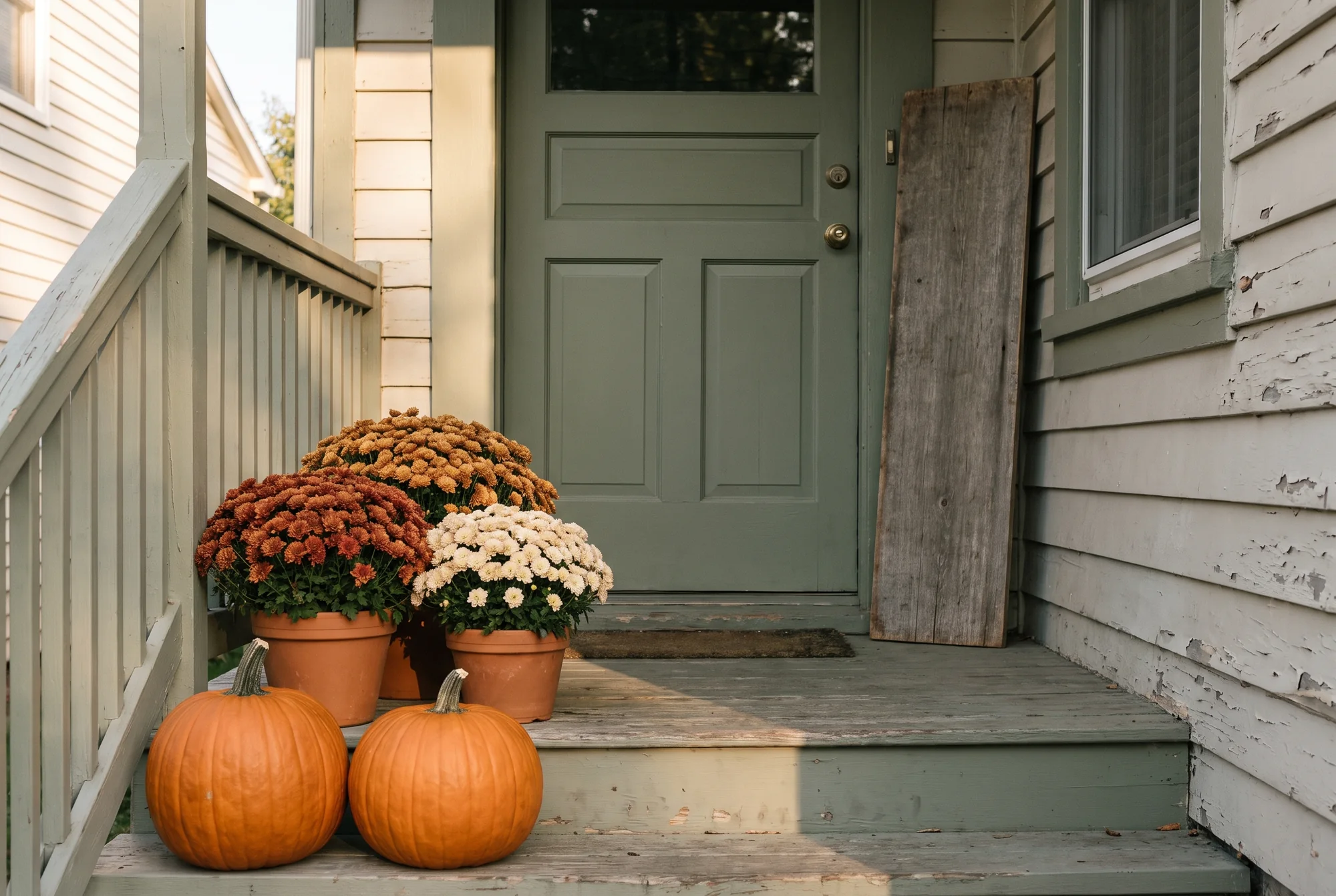
Walk into any garden centre in September and the chrysanthemums are labelled hardy mums or garden mums, as distinct from the florist kind. That word hardy does a lot of quiet work. It suggests a plant that will come back next year.
Iowa State University’s Yard and Garden service answers the question directly, and without much sympathy: “Unfortunately, fall planted garden mums usually don’t survive the winter even when given winter protection.” Their advice is to treat mums bought in late summer or autumn as temporary additions to the landscape.
The label isn’t lying, though. Garden mums genuinely are perennials, and genuinely are hardier than florist mums. The problem is when you are buying them. Illinois Extension names the mechanism plainly: “The biggest reason mums fail to overwinter is that we typically try to plant mums when they are most commonly available in the fall.” A mum bought in September gets a few weeks to put roots down before the ground freezes, and that is not enough. “Spring is the ideal time to plant mums,” they write. “Planting in spring gives the plants ample time to establish themselves in the landscape.”
So both things are true at once, which is exactly why the advice feels contradictory when you meet it in the wild. Hardy mums are perennial. The mums you buy for your porch in September are not going to behave like one.
And that is genuinely good news, because it settles a decision most people never consciously make. Once you stop treating a porch mum as a plant investment and start treating it as a seasonal object with a lifespan — closer to a bunch of cut flowers than to a shrub — everything downstream gets easier. You buy for the display, you place it for the display, and you are not quietly disappointed in April.
How to buy mums that actually last the season
If the mum is a ten-week object, the job is to get all ten weeks out of it.
Buy buds, not flowers. This is our reasoning rather than a horticulturist’s, but it follows from the above: a plant already in full open bloom has spent part of its display in the shop. A tight, budded plant with colour just showing does the same work, starting later.
Judge the plant, not the flowers. North Carolina Cooperative Extension’s advice on choosing and caring for fall mums is to “look for sturdy plants with deep green leaves,” and to avoid ones that “have been continually stressed from repeated drying and dousing.” A plant that has already been allowed to wilt on a pallet twice will not recover its schedule on your porch.
Water them like cut flowers, not like shrubs. This is the single thing that kills porch mums, and it kills them fast — a root-bound nursery pot in a windy spot can dry out in a day. The same extension guidance is blunt: “Mums don’t like for the soil to get completely dry.” Their test needs no equipment. “Pick up your pot; if it is pretty light, water it.”
Give them sun if you can. Extension advises a “mostly sunny location” for anything going into the ground or a permanent planter. A covered north-facing porch is a display shelf, not a growing spot — which is fine, as long as you know that is the trade you are making.
Double-pot instead of repotting. Leave the mum in its nursery pot and drop the whole thing inside a larger decorative vessel. You get the look of a planted urn, you can lift it out to water it properly, and you can swap a spent plant for a fresh one in ten seconds without touching soil.
11 fall porch decorating ideas
1. One big pot beats three small ones. Small pots read as clutter from the street and dry out faster. If you are buying three mums anyway, put them in one wide vessel, or group them tightly at the base of something vertical so they read as a single mass.
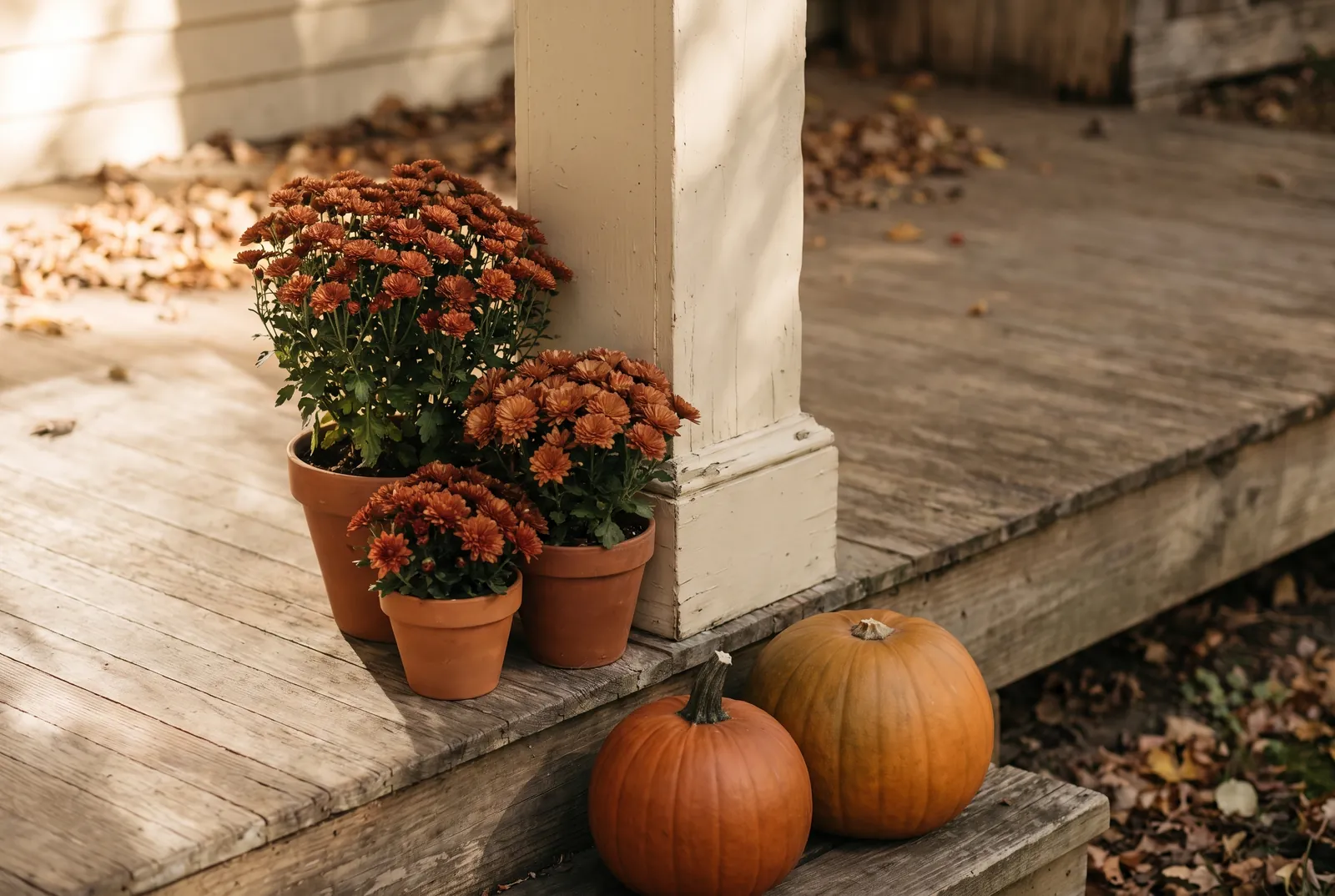
2. Decorate at eye level, not just ground level. Almost everything on a fall porch sits on the floor — pots, pumpkins, baskets. The result is a decorated step and a blank wall above it. One thing at eye level, on the door or beside it, does more for the whole picture than three more pumpkins.
3. Add a leaner. A porch leaner is a tall, narrow wooden sign that leans against the wall rather than hanging. It is the cheapest way to solve the eye-level problem, it needs no fixings at all — which matters if you rent — and it survives wind better than anything hung on a hook.
4. Keep the sign to one or two words. Hello Fall, Gather, the house number. A porch is read from a distance, usually by someone walking, often in poor light. A sentence on a sign is a sentence nobody finishes.
5. Don’t carve the pumpkins yet. This is the timing mistake that costs people the second half of the season. North Carolina Cooperative Extension puts a carved pumpkin’s life at between 8 and 11 days — and that is the figure for someone doing everything right, including a 10% bleach soak after carving and a bleach spray every single day. Without the regimen you get less. An uncarved one is a different object entirely — “if properly cured and stored, pumpkins can last for up to 3 months,” though note that figure is for proper storage, not a sunny step. Their guidance for a display pumpkin is to “place the pumpkin in a protected area away from direct sun, rain, and frost.” So: whole pumpkins from September, carving in the last week of October, and if you want faces earlier, “if you paint or use markers to decorate your pumpkin it will last much longer.”
6. Pick one pumpkin palette and hold it. All white, or all the warm oranges, or all the pale greens and greys. Mixed colours at mixed scales is what turns a porch into a pumpkin patch — and a pumpkin patch is a display, not a decorated home.
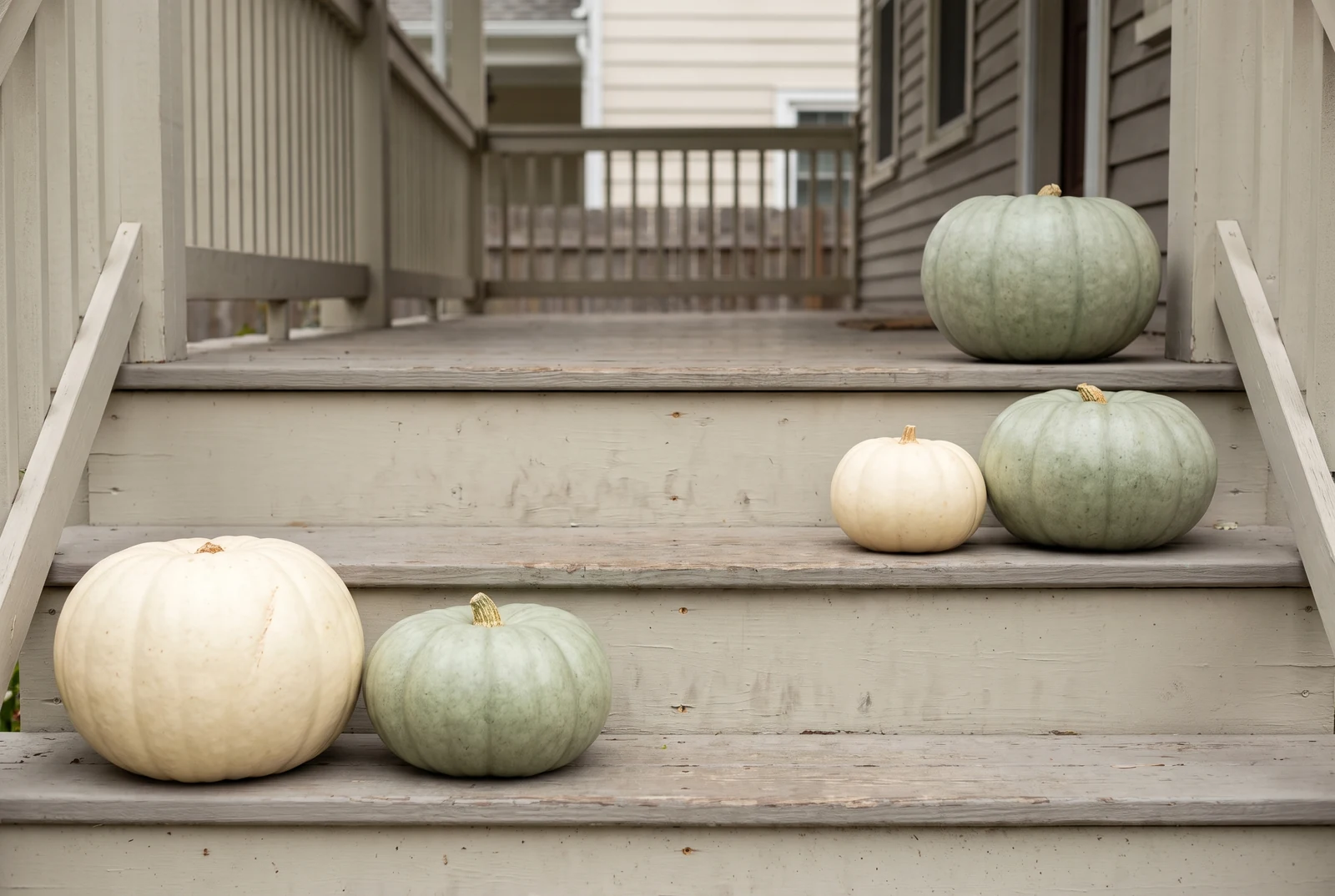
7. Repeat one thing three times. Three identical lanterns down the steps, or the same pot in three sizes. Repetition is what makes a small porch look deliberate rather than accumulated, and it is free — you are choosing sameness, not buying more.
8. Layer the doormat. A large plain coir mat with a smaller patterned one on top is the outdoor version of layering a rug, and it is the only fall porch upgrade that improves the porch on a wet Tuesday in February too.
9. Light it, because nobody sees it in daylight. By late October it is dark before most people get home. A porch decorated only for daylight is decorated for a few hours a week. Two lanterns with battery pillar candles on a timer, or a warm bulb swapped into the existing porch light, changes when the porch exists.
10. Use texture instead of more objects. A rush basket, a wooden crate, a jute runner, a galvanised bucket. Autumn reads as warm largely through rough texture, and texture does not multiply the number of things you have to store in January.
11. Leave the steps and the door swing clear. The most common fault in a saved fall porch photo is that it would be annoying to actually live with — a pumpkin exactly where your foot goes, a basket the storm door hits. Decorate the edges and the verticals; leave the traffic path empty.
Fall front door decorating ideas
The door is a separate design problem from the porch floor, and it is the part most visible from the street.
A swag instead of a wreath. A swag — a loose gathered bunch hung stem-up — uses noticeably less material than a wreath, costs less to make or buy, and reads better on a narrow or half-glazed door where a large circle looks crowded.
Flank it, don’t crowd it. Two matching planters either side of the door do more than anything applied to the door itself. If the door is off-centre in the wall or opens onto a narrow landing, use one planter on the hinge side only — a forced pair on an asymmetric doorway reads as a mistake, the same way it does above a mantel.
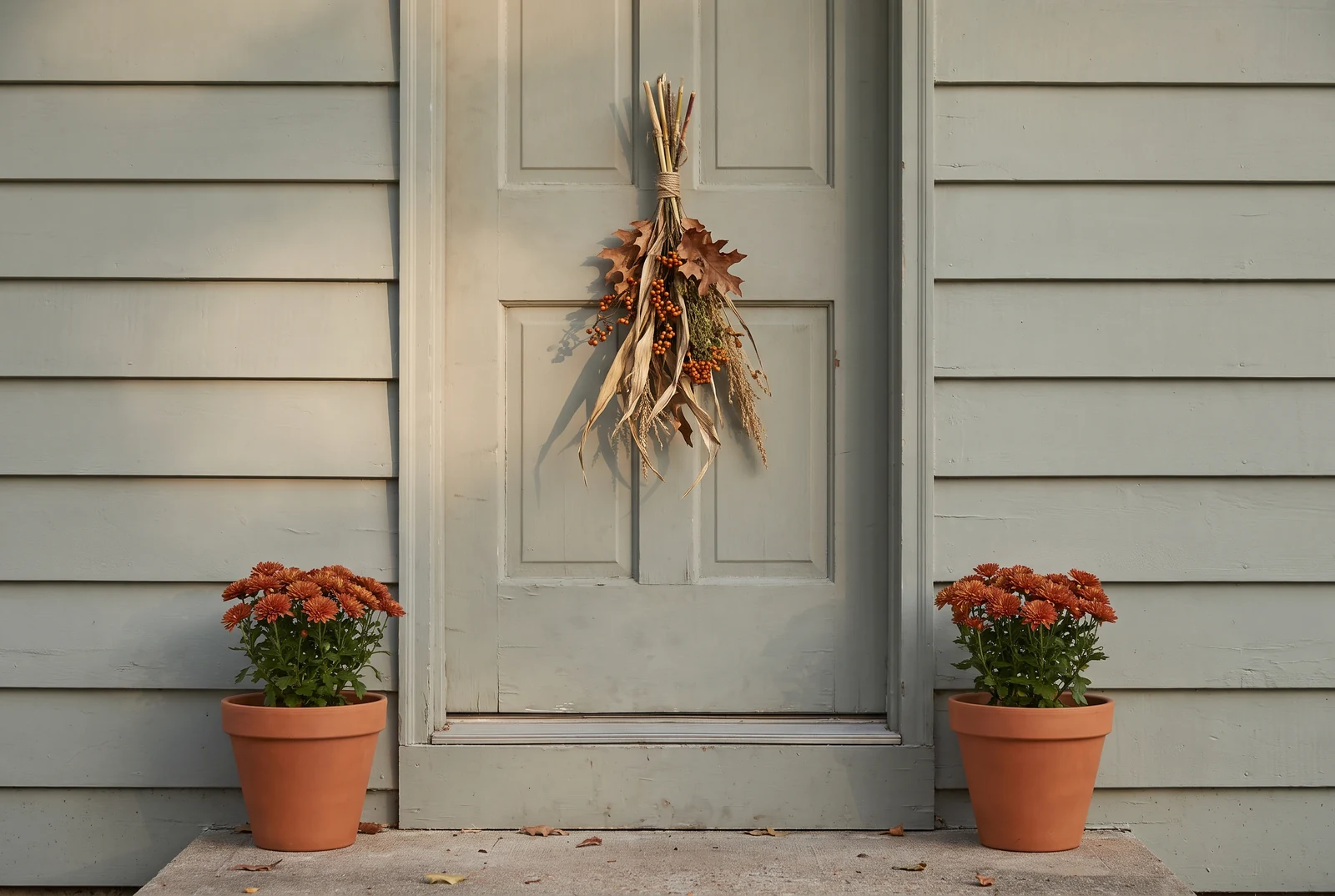
Mind what the door is made of. Anything adhesive on a painted or vinyl-clad door in direct autumn sun is a risk worth avoiding; an over-the-door hook sidesteps it entirely. Renters especially: nothing that needs a screw, and nothing that needs to come off paint in June.
Check the numbers are still readable. Fall decorating is the one time of year people cover their own house numbers with a large seasonal object and then wonder why the delivery went to the wrong address.
No porch? Fall decorating for a balcony, landing or step
Nearly every fall porch article assumes a covered porch on a detached house. Plenty of people have a balcony, a shared landing, or three concrete steps — and the constraints there are genuinely different, not just smaller.
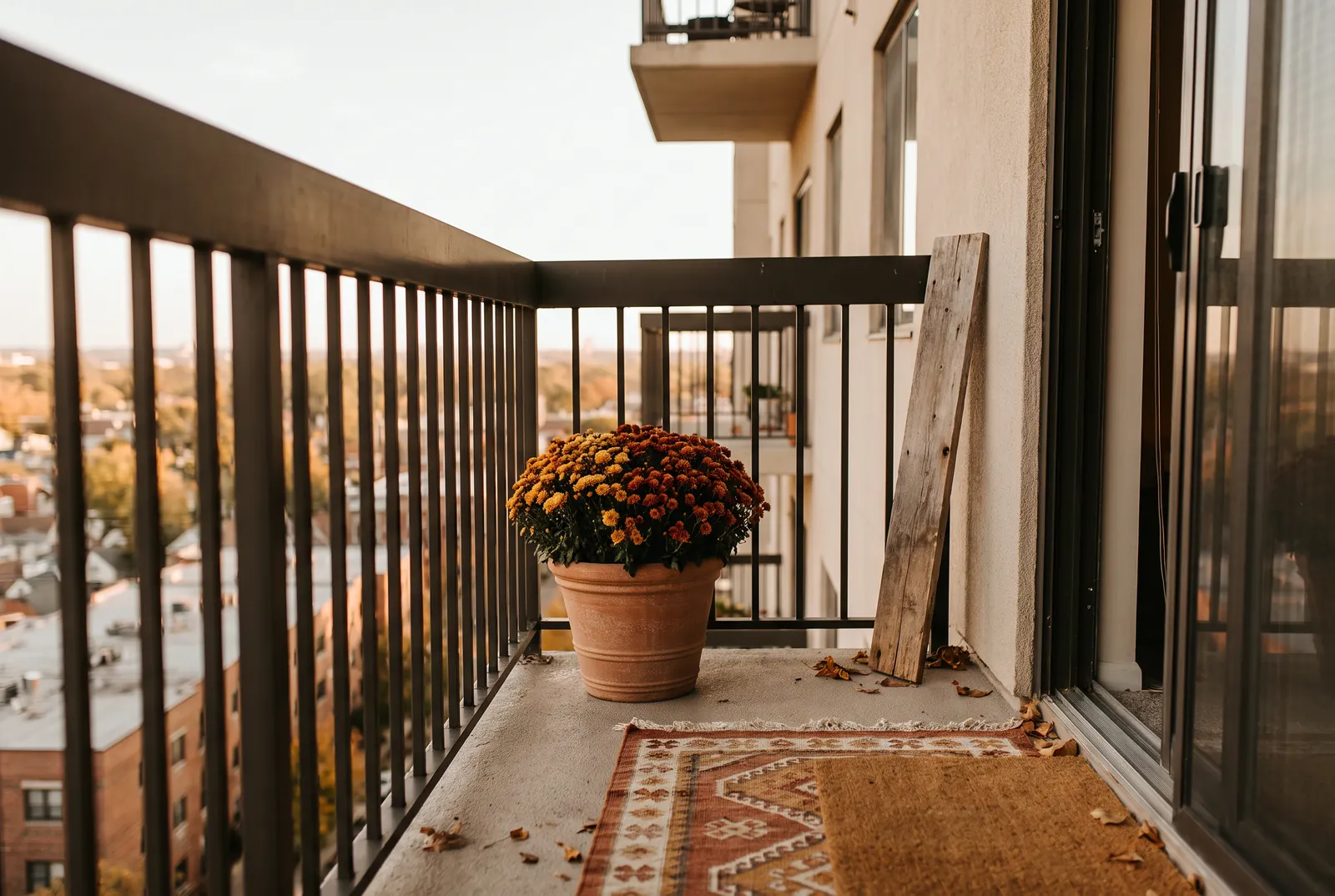
Go vertical, because the floor isn’t yours to fill. On a balcony the floor area is the usable part; on a shared landing it is often the part you are not allowed to obstruct. A leaner against your own door, a narrow plant stand, or a door decoration takes no floor at all.
Wind is the real constraint. A balcony four floors up is a different weather system from a ground-floor porch. Anything light enough to lift is a hazard to whoever is below, which rules out most dried arrangements, hollow faux pumpkins and paper anything. Weight your pots, and skip the tall lightweight leaner if the balcony is exposed.
Watering has downstairs consequences. A pot watered on a balcony drains onto someone. Use a saucer or a cachepot with no drainage hole and water sparingly — which suits the double-potting trick above.
Check the rules before you buy, not after. Shared walkways, breezeways and stairwells in apartment buildings are usually governed by the lease or by building management, and decorations in them are frequently restricted or banned outright. It is worth two minutes with your lease before you spend an afternoon on something you will be asked to remove. Your own door and your own balcony are almost always fine; the corridor outside them often is not.
A doorway is enough. One planter, one leaner or swag on the door, and a layered mat is a complete fall porch at apartment scale. The ideas above shrink better than they look — the same logic we used for renter-friendly walls applies outdoors.
When to put it up, and what to change in November
Most fall porch decorating ideas are written as though the season were a single afternoon’s work. Early September to late November is the whole run, and it is not one look.
September is the mums-and-whole-pumpkins phase. Everything is intact, nothing is carved, and the palette can stay warm and plain.
Late October is when carving makes sense — inside the 8-to-11-day window, so the faces are still good on the night they matter.
November is the swap that most people skip. Pull the spent mums, take out the orange, and let the neutrals, textures and lighting carry it. A porch that goes from harvest colours to plain wood, brass and evergreen in one afternoon buys another five weeks without buying anything, and slides straight into December.
Frequently Asked Questions
Will my fall mums come back next year?
Probably not. Iowa State Extension’s guidance is that fall-planted garden mums usually don’t survive the winter even with protection, because a plant bought in September has too little time to establish roots before the ground freezes. Hardy mums genuinely are perennials — but spring is the time to plant them for that. Treat a September mum as a seasonal object with a ten-week display life.
How do I stop my porch mums dying in two weeks?
Water, almost always. A root-bound nursery pot in wind can dry out in a day, and extension guidance is that mums don’t like the soil to get completely dry. Lift the pot — if it feels light, water it. Leaving the plant in its nursery pot inside a larger decorative one makes this much easier to keep up.
When should I carve my pumpkins?
The last week of October. A carved pumpkin lasts roughly 8 to 11 days, and that is with a full preservation routine — a bleach soak after carving and a bleach spray daily. A whole, uncarved one keeps for months in the right conditions. If you want decorated pumpkins earlier in the season, paint or draw on them instead — that lasts far longer than carving.
What are fall porch decorating ideas for a small balcony or apartment landing?
Work vertically and keep the floor clear: a leaning sign against your own door, one weighted planter, and a layered doormat. Wind matters more than you’d expect several floors up, so avoid anything light enough to blow off, and check your lease before decorating a shared walkway — those are usually restricted.
When should I put up fall porch decorations?
Early September works, and it is when garden centres have the best mums. Start with whole pumpkins and plants, carve nothing until late October, then strip the orange in November and let neutrals and lighting carry the porch into December.
Start with the ten weeks, not the photograph
If the whole thing feels like too many decisions, it reduces to one: decide what the porch has to look like in the third week of October, and buy for that.
That single change puts the mums in bud rather than in flower, keeps the pumpkins whole until Halloween is actually close, and pushes the budget towards the things that don’t wilt — the leaner, the lanterns, the mat, the pots. The plants are the part with the expiry date. Everything else you are buying once.
And once everyone is inside, our fall dining table decor guide applies the same last-the-season thinking to the table they sit at.
For the room the porch opens into, our cozy fall living room decor guide takes the same warm-palette approach indoors.