Fall Mantel Decorating Ideas: 9 That Work on a Real Fireplace
Every fall mantel you’ve saved has the same tell: a wide, deep shelf, a fire that has clearly never been lit, and roughly eleven objects arranged on it. Yours is probably narrower. It may hold a television. And if this is the autumn you actually use the fireplace, it will be sitting above real heat, not the photographed kind.
That gap is what these fall mantel decorating ideas are written for — a shelf you have to live with, not style once and photograph.
We went looking for what designers actually say about mantels and ran into the same problem we keep running into: the two most-repeated rules contradict each other, and nobody tells you how to pick. So we’ll settle that first, then get to the ideas.
The two mantel rules that cancel each other out
Homes & Gardens published six tips from interior designers on how to style a mantelpiece. Two of the six are, strictly speaking, incompatible.
Rule one: odd numbers. “I like to stick to uneven numbers,” says Luis Carmona of VERDE Interior Design. “Whether you use three or five items, odd numbers will help the mantle appear less balanced and like it is designed more organically.” Chelsea Potthast of Potthast Design lands in the same place — “always follow the rule of three.”
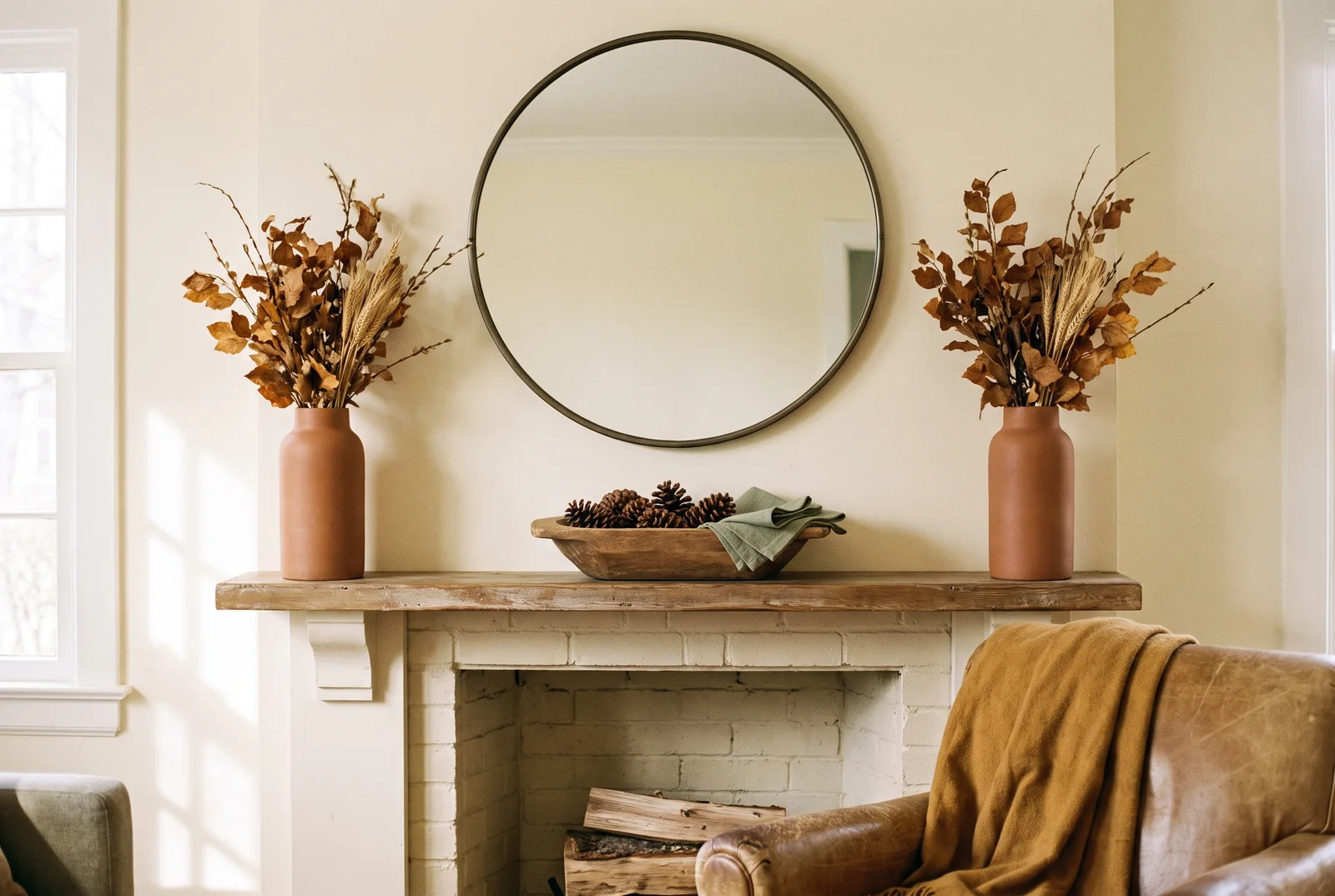
Rule two: matched pairs. “Placing matching vases or candleholders on both ends of the mantel can create a calming, symmetrical sense of balance,” says Jamie Young of Jamie Young Co.
You cannot follow both. Three candlesticks are not a symmetrical pair, and two matched urns are not an odd-numbered grouping. Both pieces of advice are perfectly good; they just belong to different mantels, and their piece — like most — presents them side by side as though you could simply pick the one you like.
How to tell which rule your mantel wants
Look up, not down.
The clue is buried in the example Homes & Gardens uses for the symmetry rule: two tall vases that “perfectly complement the height of the large artwork that boldly sits above.” That’s our reading rather than their stated rule — but it holds up everywhere we looked. Symmetry on the shelf works when something symmetrical is already anchoring the wall above it.
So:
- Large mirror or centred artwork above the mantel → matched pairs at the ends. The wall has already committed to a centre line; fighting it with a lopsided arrangement makes the whole thing look accidental.
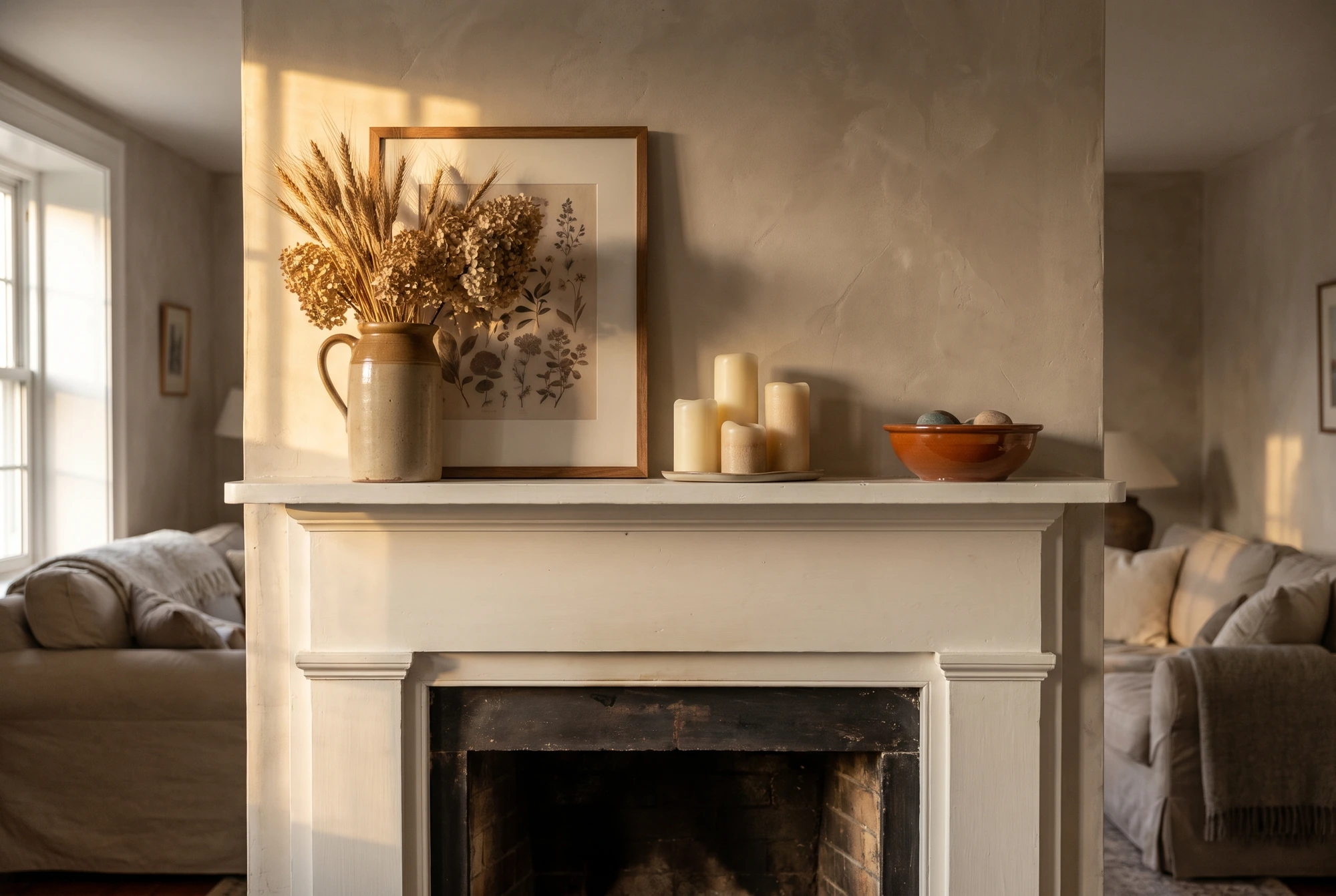
- Nothing above, or leaning and off-centre art → odd numbers. With no centre line to honour, symmetry has nothing to be symmetrical about, and reads as stiff.
- A television above the mantel → odd numbers, weighted to one side. A TV is a large black rectangle that already dominates; a matched pair on either side frames it like a shrine. Push your grouping to one end and let the other end stay nearly empty.
The one thing both camps agree on is height. “Layering accessories of varying heights is always more pleasing to the eye — start with a large piece in the back with smaller pieces in the front,” says Jamie Young. “However, be careful not to overwhelm a small mantel with too many items, as it will create too much of a cluttered look.” Jon de la Cruz of De la Cruz Interior Design puts the same idea as a formula: “Use something tall, something wide and something short.”
That’s the useful synthesis. Designers disagree about arrangement and agree about height — so if you only take one thing from this, vary the heights and stop worrying about the count.
9 fall mantel decorating ideas
1. Lean the art instead of hanging it. A leaned frame lets you change the mantel in thirty seconds all autumn, and it’s the single best move for renters — no holes, no patching. It also automatically puts you in the odd-numbers camp, because a leaning frame isn’t a centre line.
2. One vessel of dried stems, not five. Wheat, bunny tails, dried hydrangea, bittersweet. One generous pitcher reads as intentional; three small jars read as leftovers. This is where the height variation comes from — let the stems be the tall thing.
3. Change the palette, keep the objects. The cheapest fall mantel is the one you already own with three things swapped for something rust, ochre or oxblood. You do not need a seasonal object; you need a seasonal colour.
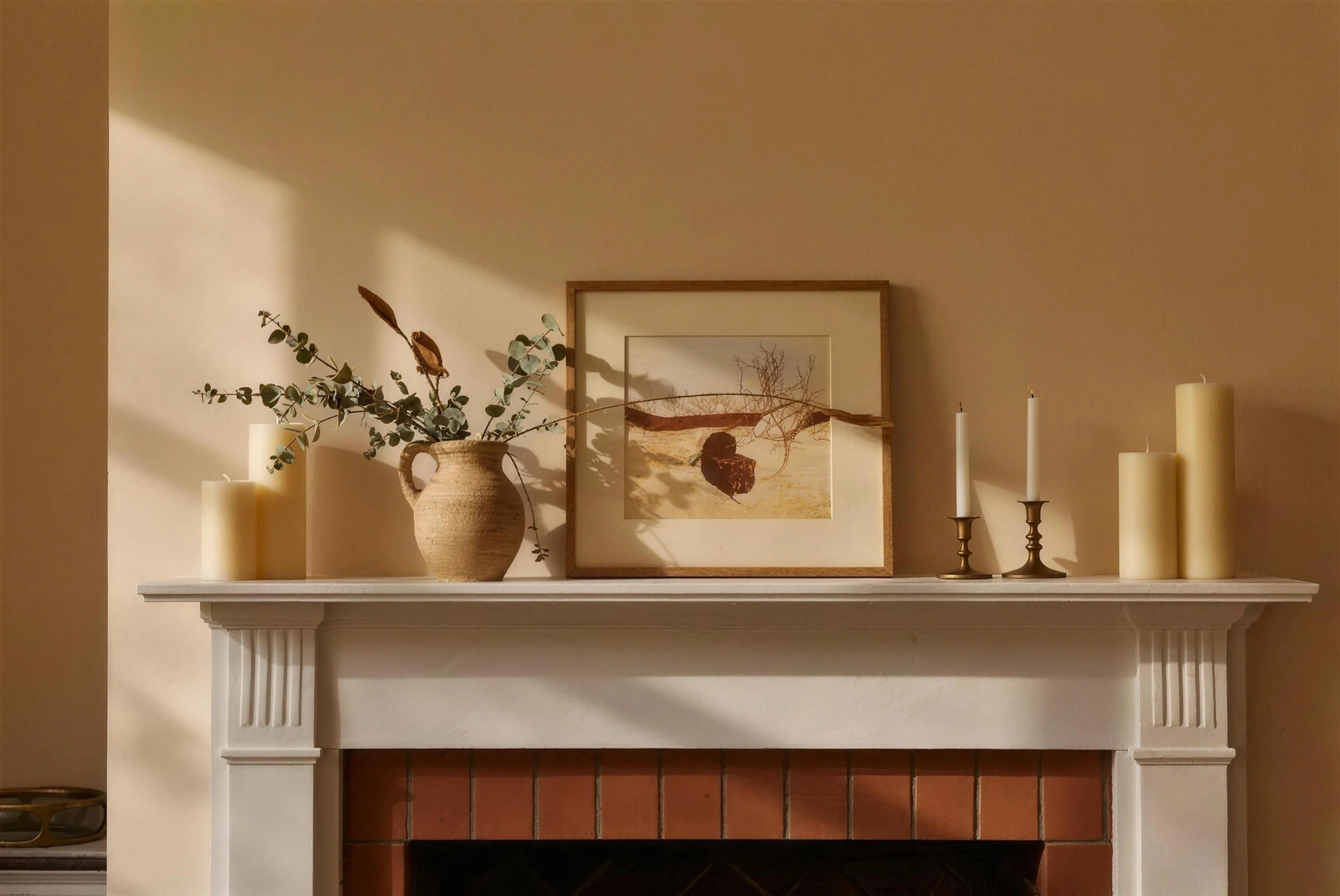
4. Pick one pumpkin material and stay with it. All ceramic, or all velvet, or all real. Mixed materials at mixed scales is what makes a mantel look like a craft-store shelf rather than a decorated room.
5. Books as risers. Two or three hardbacks under a small object solve the everything-at-one-height problem for free. Turn them spine-in if the jackets clash with your palette.
6. Let the garland stop halfway. A garland draped across the full width is symmetrical by definition — so it only works under a centred mirror. Everywhere else, start it near the middle and let it fall down one side.
7. Bring in exactly one rough texture. Fall reads as warm largely through texture: a stoneware jug, a rush basket, an unglazed vessel. One is enough. De la Cruz’s advice to mix “rough and smooth” is about proportion — one rough thing against several smooth ones, not a whole shelf of texture.
8. Give the ends different jobs. If you’re going asymmetric, the quiet end still needs something — one low, wide object. An empty end looks unfinished; a low one looks deliberate.
9. Take one thing away. Style the mantel, then remove a single object and see if you miss it. Most fall mantels are one object past their best, and a narrow shelf is past it sooner.
What changes if the fireplace actually gets lit
Nearly every fall mantel image online is styled on a firebox that is decorative, sealed, or simply never used. If yours burns, the shelf you are decorating is a heat shelf, and it’s worth knowing how seriously the building code takes that space.
The International Residential Code sets out clearances for combustible material around a masonry fireplace. Section R1001.11, Exception 4 allows a combustible mantel directly on the fireplace front, “providing such combustible materials are not placed within 6 inches (152 mm) of a fireplace opening.” And within a foot of the opening it limits how far anything may stick out: “Combustible material within 12 inches (306 mm) of the fireplace opening shall not project more than 1/8 inch (3 mm) for each 1-inch (25 mm) distance from such an opening.”
Three honest caveats. That code governs permanent construction — the mantel shelf and its trim — not the objects you set on top of it. It covers masonry fireplaces; if yours is a factory-built or gas unit, the manufacturer’s installation instructions govern instead. And the exact wording varies by jurisdiction: the text above is the IRC as adopted in North Carolina, while Illinois words the same rule as “directly above and within 12 inches (305 mm)”. The inch figures are consistent across adoptions; the millimetres and phrasing are not. So this is not a rule about your decorations.
It is, though, a useful piece of information about the space. Building officials consider the zone directly above a firebox hot enough to restrict what may be built there, with the tolerance measured in eighths of an inch. That is the zone a garland dangles into.
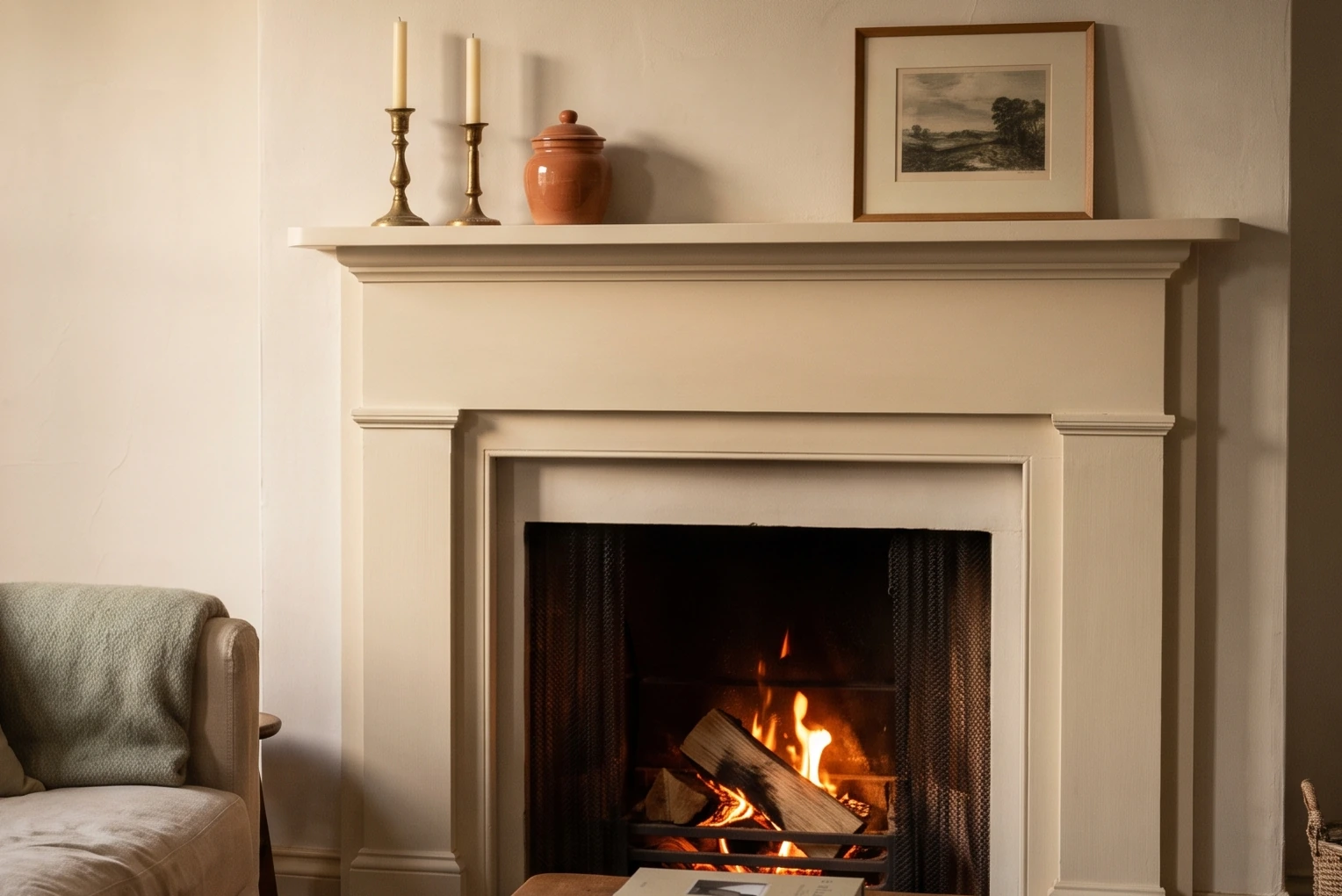
Which suggests three sensible habits, ours rather than the code’s:
- Nothing hangs below the front edge of the mantel over a working fire — garland, ribbon, dried stems, stockings.
- Dried botanicals are kindling. Dried is precisely the state that makes wheat and eucalyptus attractive in autumn and flammable in general. Keep them to the ends, away from the centre, or use them on the mantel only when you aren’t lighting fires.
- Use flameless candles above a working firebox. Real candles are the obvious hazard, but the boring failure comes first: wax softens and slumps from below long before anything ignites.
None of this means you can’t decorate a working fireplace. It means the arrangement wants to sit on the shelf rather than spill off the front of it — which, conveniently, is also the tidier look.
No mantel? Three ways to get the shelf anyway
Plenty of apartments have no fireplace at all, and the whole genre quietly assumes you do.
A picture ledge at mantel height. A shallow picture ledge, mounted at about the height a real mantel sits, gives you the same styling surface and the same proportions for the price of one shelf. It’s the closest thing to a real mantel and it takes the same arrangement rules.
A console against the wall the fireplace should have been on. Rooms usually have an obvious focal wall. A narrow console there, styled tall-wide-short, does the same job for the room’s balance.
A leaned arrangement on the floor. A large frame or mirror leaned against the wall with two or three objects at its base is a mantel vignette without the shelf — and it’s the renter-friendliest option of all, since nothing touches the wall.
If you go the ledge route, the same no-damage hanging methods apply as in our renter friendly gallery wall guide, and the height reasoning is the same one we worked through for corner gallery wall ideas.
Frequently Asked Questions
How many items should be on a fall mantel?
Three to five works for most shelves, but the count matters less than the heights. Designers split on odd numbers versus matched pairs — use matched pairs when a large mirror or centred artwork hangs above, and odd numbers when it doesn’t. Then remove one object and see if you miss it.
What height should things be on a mantel?
Vary them deliberately: something tall, something wide, something short. Layer larger pieces behind smaller ones. On a narrow shelf, fewer objects at more distinct heights beats more objects at similar heights.
Is it safe to put a garland or dried stems on a mantel?
Over a fireplace you never light, yes. Over one you do, keep anything combustible from hanging below the front edge of the mantel, and keep dried botanicals to the ends rather than the centre. Building codes restrict what may even be built within 12 inches of a firebox opening, which is a fair indication of how warm that zone gets.
How do I decorate a mantel with a TV above it?
Treat the TV as the centred anchor it already is, then refuse to frame it symmetrically. Weight your grouping to one end and leave the other end nearly bare, so the arrangement reads as a mantel with a TV rather than a TV with two matching vases.
When should I put up fall mantel decor?
Early September through late November covers it. Swapping the palette rather than the objects — rust, ochre and oxblood in place of your usual colours — means the changeover takes minutes rather than an afternoon.
Start with the wall, not the shelf
If the whole thing feels like too many decisions, it collapses into one: look at what’s above the mantel, let that decide symmetry or asymmetry, and then vary your heights. Everything else on this list is a variation on those two moves.
And if the fireplace works, keep the arrangement on the shelf rather than over the edge of it. That’s the version that lasts the season.
For the rest of the room, our cozy fall living room decor guide covers the same warm-palette approach applied to the sofa, the lighting and the floor.
The dining table is the other surface worth thinking about this month, and it plays by different rules — our fall dining table decor guide is built around the fact that it gets cleared every single night.
And if the fall styling is heading outdoors too, our fall porch decorating ideas guide applies the same last-the-whole-season test to mums, pumpkins and the front door.